

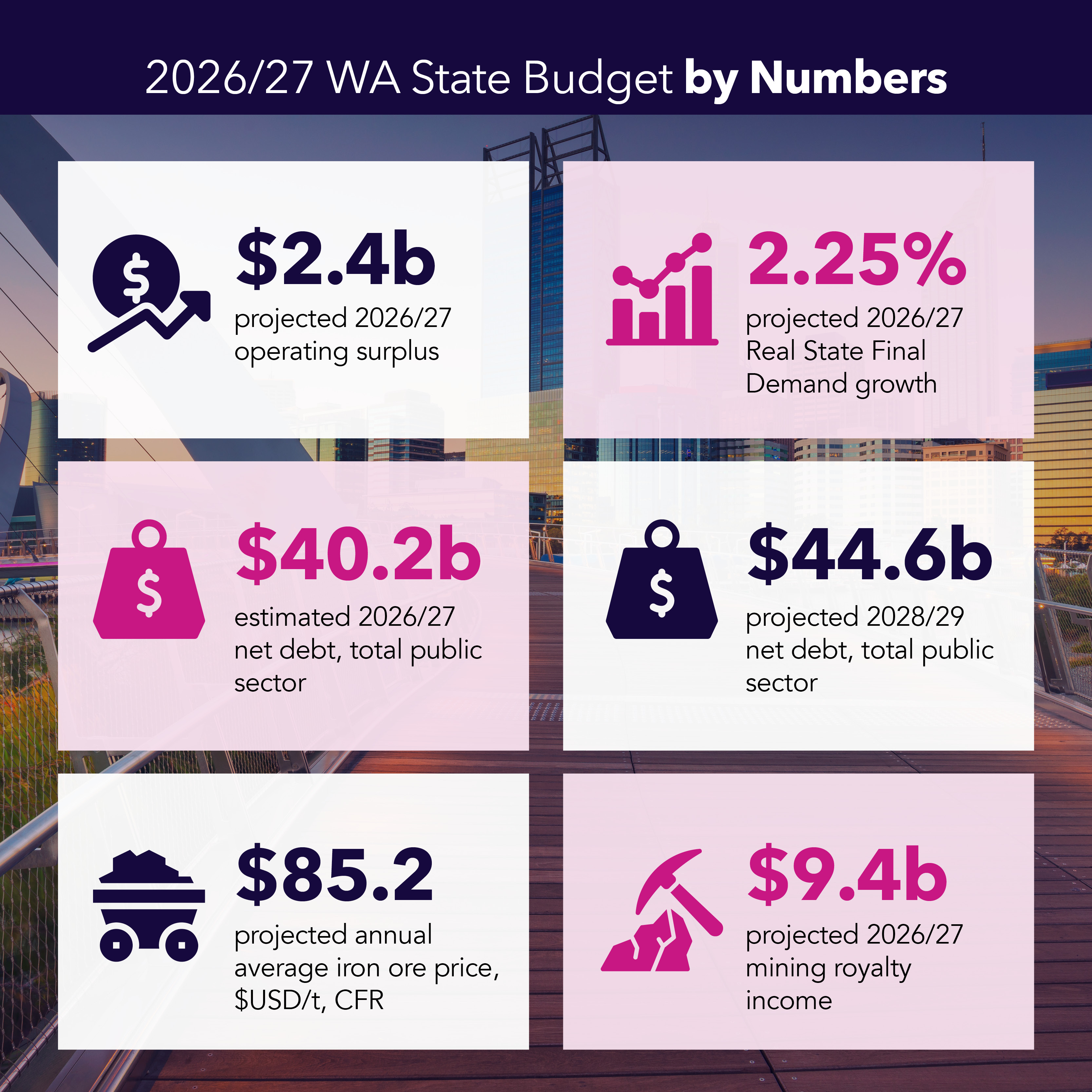
$2.4b
Projected operating surplus
$40.2b
Projected net debt
Treasurer Rita Saffioti has handed down her third budget, and the tenth of the WA Labor Government. Once again, significant unexpected revenue has been directed towards the Government’s medium-term priorities and the main pressure points of the WA electorate – housing, health and cost-of-living relief.
But with debt due to reach the psychological and political barrier of $40 billion in the coming financial year (up to $44.6 billion by 2028/29), cost of living assistance has been reined in from COVID levels.
The Government has announced it will proceed with voluntary redundancies for 1,500 public servants, arguably its first difficult decision in some time. This could be a reaction to the reported blow-out in public servants in recent years or just a sensible reshaping of the sector.
While Canberra rumours point to potential changes to tax and revenue measures in next week’s Federal Budget, the WA Government has continued to adopt a cautious and conservative approach with no revenue surprises to impact industry.
The State Budget remains in an operating surplus, projected to record a $3.5 billion surplus in 2025/26, and remain in surplus across the forward estimates. Windfall revenues continue to arise from stamp duty, land tax, payroll tax, Commonwealth grants, royalties and Government Trading Enterprise dividends.
Underlying that result however is continued year on year expense growth, rising faster than revenue. Together with a still substantial Asset Investment Program, it’s driving the projected rise in net debt to over $40 billion in 2026/27, before hitting $44.6 billion in 2028/29.
The Government, however, is keen to point out that this level of debt is low relative to other Australian states, currently at 7.1 per cent of GSP, finishing at 8.9 per cent by 2029/30. By contrast, all other states are projected to be rising well into the double digits, with the mendicant Victorian debt burden due to plateau at around 20 per cent.
The budget papers highlight ongoing risks to fiscal performance, including from commodity prices (to both royalty income and payroll tax), the productivity commission review of GST grants, as well as ongoing geopolitical risks.
Western Australia is currently the only state or territory with a triple‑A credit rating from both S&P Global and Moody’s Ratings. This is a clear source of pride within the WA Government and remains a clear focus for the Treasurer and her Cabinet colleagues.
This year, significant additional investments in pressing political priorities took centre stage – across housing ($4.7 billion), health ($9.1 billion) and cost-of-living relief (over $1 billion).
Budget day announcement honours went to cost of living relief, with $198 million for the novel Fuel Support Payment providing $100 to all Western Australians with a driver’s licence and $89.5 million to deliver a third round of the WA Student Assistance Payment.
However, this year has also seen the Government pursue savings measures including:
Despite global economic headwinds, the WA Labor Government continues to benefit from strong growth across its main revenue streams – royalties, stamp duty and payroll tax.
The strong revenue has enabled the Government to focus on addressing the challenges facing the WA community, with significant expenditure in the health system, housing supply and cost-living-relief.
In many respects this budget doesn’t contain any new surprises and reflects the consistent, disciplined economic management of the Government since 2017.
The decision to utilise other relief mechanisms such as fuel support and student assistance payments rather than electricity rebates is noteworthy, particularly given the Government’s focus on the energy sector in WA.
The 2026/27 Budget, as a political plan, addresses some of the pain points in the electorate, provides comfort to ratings agencies and provides space for future funding challenges such as Westport and energy transmission infrastructure.
The Government will be acutely aware of the challenges around delivery of projects and the Opposition’s claims of being driven by announceables alone.
With almost three years until the next election, the Government has time on its side, but can’t afford delays or blow-outs, particularly on its housing initiatives.
Reach out to our Western Australian team if you would like to discuss the new Western Australian Budget and what it means for you.
Bruce Campbell-Fraser, Partner and Perth Office Head – [email protected]
Joey Armenti, Senior Adviser – [email protected]
Cale Herbert, Associate Partner – [email protected]
SEC Newgate’s integrated approach draws on our national team’s experience and networks to deliver a full service offering.